What Is MVP Development? A Founder’s Practical Guide

Learn what MVP development means, why startups use it, how to build an MVP, and how to avoid common mistakes before investing in a full product.
Launching a startup does not require building every feature you can imagine. It requires building the smallest version of your product that solves a real problem for real users.
That is the idea behind MVP development.
For founders, an MVP is more than a cheaper first version of an app. It is a practical way to test whether people truly need your solution before you spend months, or your entire budget, building a full product.
In this guide, we explain what MVP development means, how it works, what to include in an MVP, and how to launch one without losing focus.
What Is MVP Development?
MVP stands for Minimum Viable Product.
MVP development is the process of designing, building, testing, and launching the simplest usable version of a software product. It includes only the essential features needed to solve one core user problem and collect real feedback.
For example, imagine you want to build a platform that connects local service professionals with customers.
A full product may eventually include:
- Customer and provider mobile apps
- Online payments
- Reviews and ratings
- Live location tracking
- Subscription plans
- Referral rewards
- Advanced analytics
- AI recommendations
But an MVP may begin with only:
- Customer sign-up
- Service request form
- Provider dashboard
- Booking confirmation
- Basic admin panel
The goal is not to build a limited product forever. The goal is to learn what users value before investing in features they may never use.

Why Do Startups Need an MVP?
Most startup ideas fail not because the technology is poor, but because founders spend too much time building before validating the problem.
MVP development helps reduce that risk.
Validate your idea with real users
Friends, surveys, and assumptions can be useful, but real user behaviour is more valuable. An MVP lets you see whether people sign up, use the product, return to it, and pay for it.
Launch faster
Instead of waiting six months to build a complete platform, you can launch a focused product in weeks. This gives you a faster route to market feedback.
Reduce development costs
By prioritising only the must-have features, you avoid spending money on complex functionality before you know it is needed.
Attract investors and early customers
A working MVP is far more convincing than a pitch deck alone. It gives investors, pilot customers, and early adopters something real to evaluate.
Build based on evidence, not assumptions
After launch, you can use feedback and product data to decide what to improve next. This makes future development more strategic.
MVP vs Prototype vs Full Product
These terms are often used interchangeably, but they serve different purposes.
| Type | Purpose | Is it usable by real customers? |
|---|---|---|
| Prototype | Demonstrates an idea, flow, or design | Usually no |
| MVP | Solves a core problem with essential features | Yes |
| Full product | Includes broader features, refinements, and scale-ready functionality | Yes |
A prototype helps you visualise an idea. An MVP helps you validate it in the market. A full product is built after you have more confidence in what customers need.

What Should an MVP Include?
Your MVP should include only what is necessary for a user to complete the primary action that creates value.
Ask these questions:
- Who is the first user we want to help?
- What single problem are we solving for them?
- What is the most important action they need to complete?
- What features are essential for that action?
- What can wait until after launch?
For a food-delivery startup, the core user journey may be:
Browse restaurants → select items → place an order → receive confirmation.
Features such as loyalty programmes, advanced recommendation engines, multiple languages, or in-app social features can come later.
A good MVP is focused. It does not try to satisfy every possible customer need on day one.
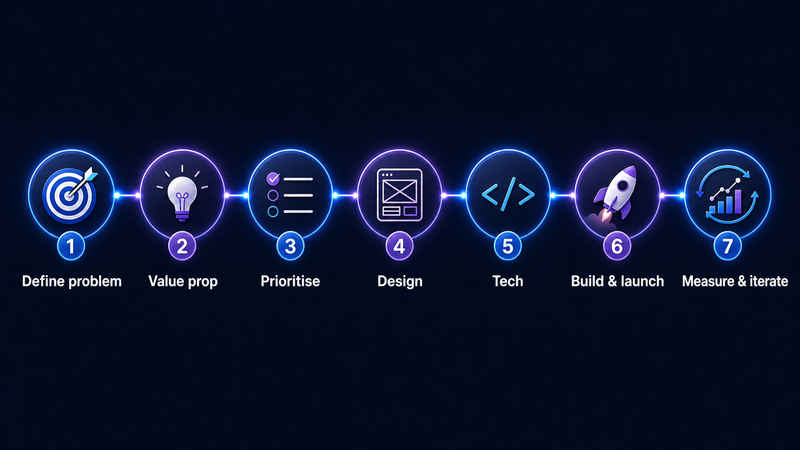
The MVP Development Process
1. Define the problem and target user
Start with the problem, not the technology.
Be clear about who you are building for, what frustrates them today, and why your solution matters. A vague audience creates a vague product.
2. Identify the core value proposition
Write one simple statement:
“We help [specific user] achieve [specific outcome] by [how the product works].”
This statement becomes the foundation for your MVP scope.
3. Prioritise features
List every feature idea, then divide them into:
- Must have
- Should have
- Could have
- Not now
Your first MVP should mostly contain “must-have” features. The discipline to say “not now” is one of the most important parts of product development.
4. Create user flows and UX/UI designs
Before development starts, map the main paths users will take through the product. Wireframes and clickable designs help identify confusion early, when changes are faster and less expensive.
5. Choose the right technology approach
The right stack depends on your product, timeline, budget, integrations, and growth plans.
For example:
- A SaaS platform may need user roles, billing, dashboards, and secure data management.
- A marketplace may need profiles, listing management, matching, and payments.
- An AI MVP may need a clean interface, model integration, data handling, and usage controls.
- A mobile MVP may use cross-platform development to launch on iOS and Android faster.
The goal is not to use the most complicated technology. It is to use a reliable approach that supports your first launch and future iteration.
6. Build, test, and launch
Development should happen in focused sprints, with regular demos and feedback. Before launch, test the important user journeys thoroughly: sign-up, core actions, notifications, payments, and admin workflows.
Then launch to a defined group of early users rather than trying to reach everyone at once.
7. Measure, learn, and iterate
After launch, track what users actually do.
Useful MVP metrics may include:
- Sign-ups
- Activation rate
- Feature usage
- Repeat usage
- Customer feedback
- Conversion rate
- Retention
- Cost to acquire a customer
Use those insights to decide which feature deserves investment next.
Common MVP Development Mistakes
Building too many features
Feature overload is the most common MVP mistake. If everything is important, nothing is prioritised.
Confusing “minimum” with low quality
An MVP should be simple, but it should still be usable, secure, and professional. Early users will judge your product based on their first experience.
Skipping discovery and planning
Starting development without clear requirements usually leads to delays, scope changes, and unnecessary costs. A short discovery phase saves time later.
Copying competitors blindly
Competitor research is useful, but your MVP should focus on the problem you are uniquely solving. You do not need to replicate every feature of an established product.
Ignoring user feedback
Launching is only the beginning. If you do not collect feedback and make informed changes, you miss the main advantage of building an MVP.
How Long Does MVP Development Take?
The timeline depends on the product’s complexity, number of platforms, integrations, and design requirements.
A focused web or mobile MVP can often be launched in 4 to 12 weeks. More complex products, such as marketplaces, fintech platforms, or AI systems with custom workflows, may require longer.
The fastest path is not cutting corners. It is defining a clear scope and building only what is necessary for the first learning cycle.
How Much Does MVP Development Cost?
MVP development costs vary based on:
- Product complexity
- Web, mobile, or both
- Number of user roles
- Third-party integrations
- Payments, maps, messaging, or AI features
- Design requirements
- Admin dashboard and reporting needs
- Security and compliance requirements
The best way to estimate an MVP is to first define the problem, user flows, and essential features. A clear scope produces a more realistic timeline and budget.
Build the Right First Version
A successful MVP is not the product with the fewest features. It is the product with the clearest purpose.
It helps you test a real business assumption, learn from real users, and make smarter decisions about what to build next.
At Hexanova, we help founders turn early-stage ideas into focused web, mobile, and AI-powered MVPs. From discovery and feature prioritisation to design, development, launch, and iteration, we build products that are ready for real users, not just presentations.
Have an idea you want to validate? Book a free MVP discovery call, explore our MVP development services, or talk to our web development company in Jamshedpur.